Selecting the Right Rogowski Coil: Accuracy Considerations for Current Measurements
- Posted by Neo Messtechnik
- On 24. April 2026
- 0 Comments
When selecting Rogowski coils for current measurements, one question comes up frequently: “Does the coil diameter determine which currents I can measure?” The short answer is no – but there’s an important nuance. While modern Rogowski coil systems can measure a wide range of currents regardless of coil size, the relationship between coil diameter and conductor diameter significantly impacts measurement accuracy. Understanding this relationship is essential for achieving reliable, high-quality measurements.
Table of Contents
Understanding Rogowski Coil Fundamentals
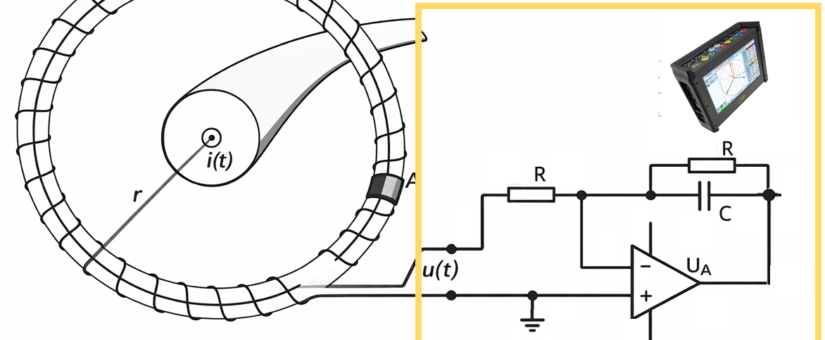
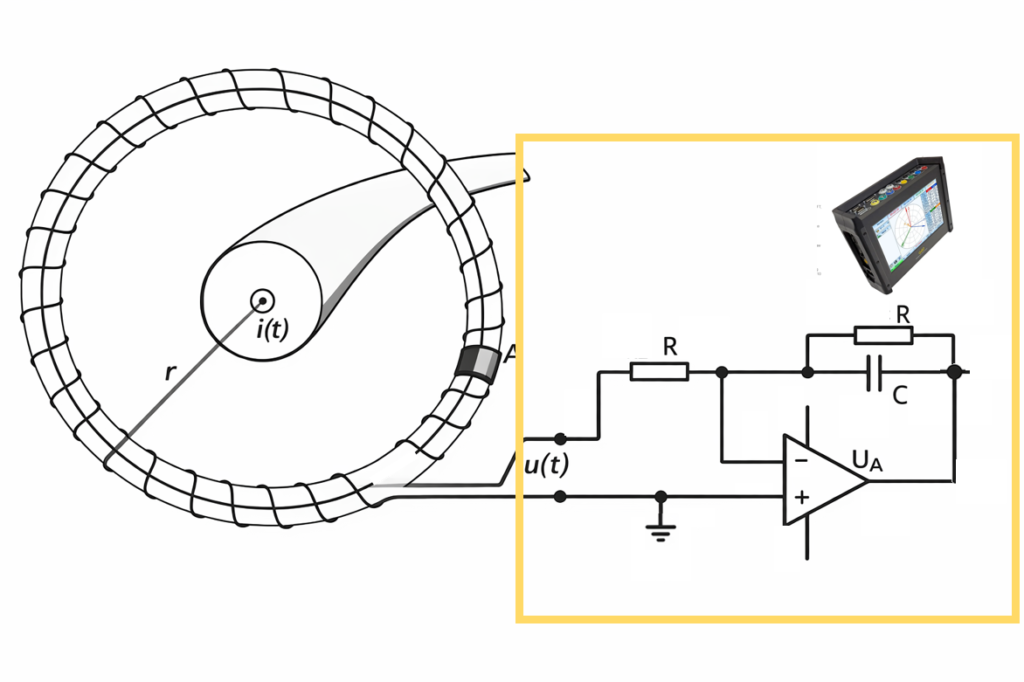
Rogowski coils are flexible, air-core current sensors that operate on the principle of electromagnetic induction. Unlike traditional current transformers with iron cores, they measure the rate of change of current (di/dt) and require an integrator circuit to reproduce the actual current waveform. This air-core design offers significant advantages:
- no magnetic saturation,
- excellent linearity,
- and the ability to measure very large currents.
However, this flexibility in design also means that proper coil selection requires understanding how physical dimensions affect measurement performance.
The NEO Approach: Integrated Intelligence
Many Rogowski coil vendors supply coils with separate external integrators. While functional, this approach has notable limitations: it requires an external power supply, and the measurement range must be selected externally and manually considered in the software. This introduces potential for configuration errors and complicates the measurement setup.
NEO Messtechnik takes a different approach by integrating the integrator circuit directly inside the measurement instrument.
This design delivers several key benefits:
- No external power supply required – simplified setup and reduced points of failure
- Wide measurement range independent of coil length and diameter – from small to very large currents
- Automatic range selection in software – eliminates manual scaling errors and configuration mistakes
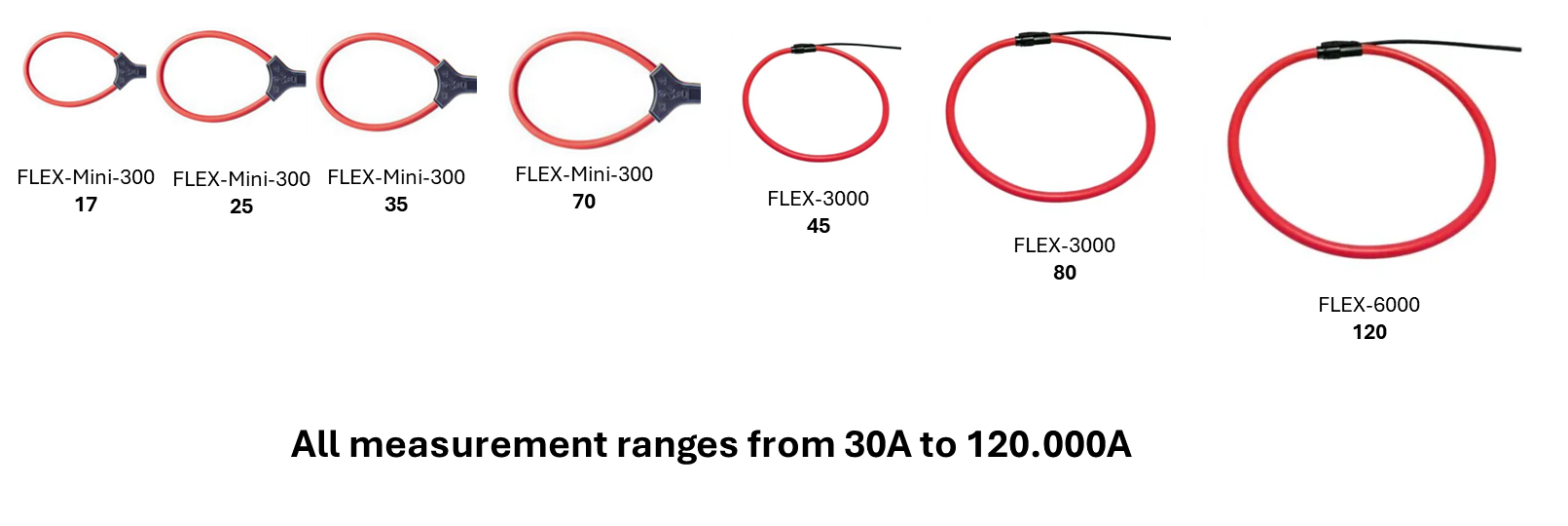
- Flexible measurement capability – NEO Messtechnik offers 15 measurement ranges from 30A to 120,000A
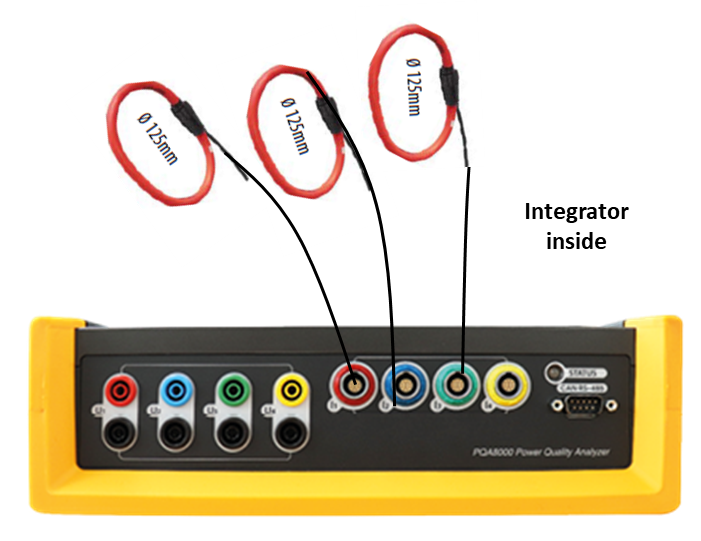
This architecture means that, from a technical standpoint, you can use any Rogowski coil diameter to measure currents across the entire range spectrum. A FLEX-MINI-300 with a 45mm inner diameter can theoretically measure the same currents as a FLEX-6000 with a 250mm inner diameter. However, this technical capability doesn’t tell the complete story about measurement performance.
NEO’s Calibration Advantage: Beyond Standard Accuracy
While the integrated integrator provides flexibility and convenience, NEO Messtechnik takes accuracy a step further through comprehensive sensor calibration. Every Rogowski coil supplied by us undergoes two distinct calibration processes that significantly improve measurement precision beyond standard manufacturer specifications.
Frequency-Dependent Calibration
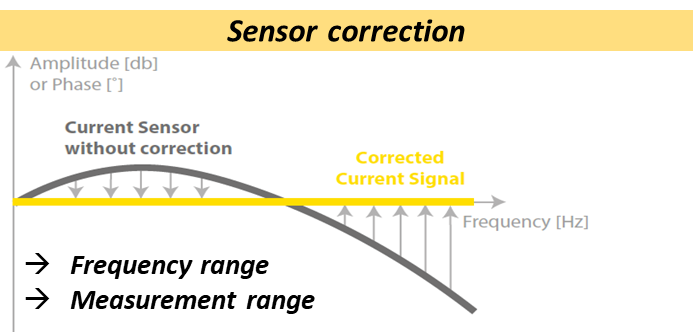
Rogowski coils, like all AC current sensors, can exhibit frequency-dependent behavior – slight variations in amplitude response and phase shift across different frequencies. We calibrate each sensor across its entire frequency bandwidth and applies corrections for frequency-dependent phase shift and amplitude damping. This ensures high precision whether you’re measuring 50/60Hz power frequency, variable frequency drives at several hundred Hz, or high-frequency switching transients up to 100kHz and beyond.
Measurement Range-Dependent Calibration
Beyond frequency correction, we perform multi-point calibration across each measurement range. Rather than calibrating at a single nominal point, each sensor is calibrated at six points (2%, 10%, 30%, 50%, 80%, and 100%) of nominal range.
The result: NEO-calibrated Rogowski coils typically achieve accuracy of 0.3% of reading or better across their measurement range, compared to the standard specification of uncalibrated coils.
Further Information: All sensors will be delivered with a standard calibration, which improves the accuracy compared to nominal specifications, whereas the NEO calibration will be performed on each individual sensor and needs to be ordered separately.
The Critical Factor: Conductor-to-Coil Diameter Ratio
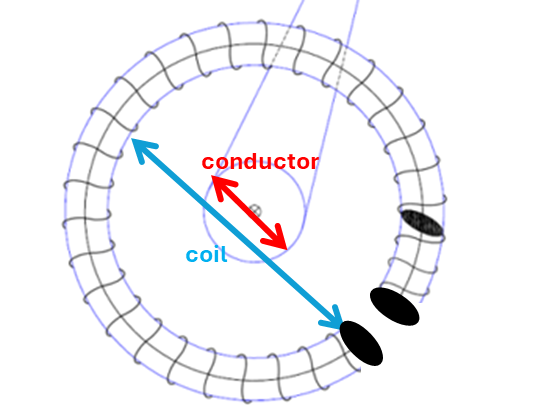
While our integrated approach allows any coil to measure a wide current range, the physical relationship between the conductor being measured and the coil diameter has a significant impact on measurement accuracy. Specifically, when the conductor diameter is very small compared to the coil diameter, two accuracy-degrading effects become pronounced:
Positional Sensitivity
Rogowski coils are designed to measure current independent of conductor position within the coil loop – in theory. In practice, manufacturing variations in winding density and coil cross-sectional area mean that the sensor output varies slightly depending on where the conductor sits inside the coil. When the conductor is small relative to the coil, even minor positioning variations can significantly affect the reading.
Consider the practical implications: A 10mm conductor in a 250mm coil can easily shift position during installation or due to thermal expansion. Each position change introduces a measurement error. The same 10mm conductor in a 45mm coil is inherently more centered and stable, with less opportunity for positional variation.

| Position | Accuracy |
| center | 1% manufacturer (NEO 0,5%) |
| up | up to 2% |
| right | up to 2% |
| down | up to 5% (connection of coil) |
| left | up to 2% |
| vertical 1 | up to 10% |
| vertical 2 | up to 10% |
| horizontal 1 | up to 4% |
| horizontal 2 | up to 4% |
As a general rule of thumb, positional accuracy errors increase as the coil-to-conductor ratio grows larger. Small conductors in oversized coils can experience accuracy variations of several percentage points depending on position, while properly matched coil sizes typically keep positional errors well under 1%.
This is why it’s important that the difference between conductor and coil diameter is not too high to ensure consistent, reliable measurements.
Critical Positioning Zones
Not all positions within a Rogowski coil are equal. The area where the coil clips together – the termination point – represents the worst-case scenario for positional accuracy. This is due to the necessary discontinuity in the winding at this junction point. When working with small conductor-to-coil ratios, keeping the conductor away from this termination area becomes increasingly important. With a properly sized coil, the conductor naturally stays closer to the center, making inadvertent placement in problematic zones less likely.
External Interference Rejection
Rogowski coils include design features to reject currents flowing in conductors external to the measurement loop. However, when a small conductor carrying the current of interest sits inside a large coil, nearby external conductors can more easily create interference. This means that accuracy can be reduced by up to 1%. The effectiveness of the coil’s common-mode rejection depends partly on the geometric relationship between the measured conductor and the coil itself. A better-matched conductor-to-coil ratio improves the signal-to-noise ratio and makes the coil’s interference rejection mechanisms more effective.
Practical Selection Guidelines
Based on these accuracy considerations, here’s how to approach Rogowski coil selection for your application:
Match Coil to Conductor Size
Start by measuring or estimating your conductor diameter:
- Small conductors (up to ~45mm): FLEX-MINI-300 (170mm coil length, 45mm inner diameter)
- Optimal for cables, small busbars, and standard power conductors
- Provides best accuracy for typical industrial and commercial applications
- Medium conductors (50-125mm): FLEX-3000 (450mm coil length, 125mm inner diameter)
- Well-suited for larger cables, medium busbars, and transformer connections
- Balances flexibility with accuracy for industrial power systems
- Large conductors (125-250mm): FLEX-6000 (800mm coil length, 250mm inner diameter)
- Designed for large busbars, generator connections, and high-power applications
- Maintains accuracy even with the largest conductors
Consider Your Installation
Beyond conductor size, think about the physical installation:
- Access constraints: Sometimes a larger, more flexible coil is necessary simply to fit around the installation, even if a smaller coil would provide better accuracy
- Multi-conductor measurements: When measuring multiple conductors in close proximity, positioning becomes even more critical
- Permanent vs. temporary: Permanent installations benefit more from optimal sizing since positioning will be fixed
Verify Current Ranges
While all NEO Rogowski coils can measure from 30A to 120.000A (across 15 selectable ranges), confirm that your expected current falls comfortably within this range. For applications at the extreme ends of this spectrum, contact NEO Messtechnik support to discuss optimal configuration.
Additional Accuracy Factors
Beyond the conductor-to-coil ratio, several other factors influence Rogowski coil measurement accuracy:
- Avoid external interference from other conductor when the coil is too close to other conductors.
- Coil Integrity: Ensure the coil closing mechanism is properly engaged. An incompletely closed coil loop will produce significant measurement errors regardless of sizing.
- Cable Routing: Keep the Rogowski coil’s output cable away from high-voltage conductors and sources of electromagnetic interference. While the coil itself has good common-mode rejection, the output cable can still pick up interference.
- Temperature Stability: All NEO Rogowski coils have low temperature coefficients (typically ≤0.1% per 10°C), but for the most demanding applications, allow the measurement system to stabilize at the operating temperature before taking critical measurements.
- Calibration: NEO Rogowski coils are factory calibrated, and with proper use, this calibration remains stable. However, for critical applications or where absolute accuracy is required, periodic recalibration services are available.
The Bottom Line
The flexibility of NEO’s Rogowski coil system – with integrated integration, automatic ranging, and wide measurement capability – means you have genuine options when selecting coils. The technical capability exists to measure any current in the supported range with any coil diameter. However, for optimal accuracy, the key principle is straightforward: match your coil diameter to your conductor size, ensuring the difference between conductor and coil diameter is not too high.
When in doubt, choosing a smaller coil that fits your conductor provides better accuracy than oversizing. The only scenario where a larger coil is preferable is when physical access or installation constraints make it necessary – and even then, careful attention to conductor positioning can minimize accuracy impacts.
Need Help Selecting the Right Coil?
Choosing the optimal Rogowski coil for your specific application doesn’t have to be complicated. Our technical support team has extensive experience matching coils to applications across industries – from power quality monitoring to motor drive testing, from grid infrastructure to laboratory research.
If you’re unsure which coil configuration will provide the best results for your measurement scenario, or if you have questions about accuracy requirements for your specific application, our team is here to help. Contact us at support@neo-messtechnik.com or visit www.neo-messtechnik.com for detailed technical specifications and selection guidance.
Whether you’re measuring currents in compact electrical panels or on large industrial busbars, the right Rogowski coil selection ensures you get accurate, reliable data – and that’s what matters most.
Contact us:
- Phone: +43 2642 20301
- Email: sales@neo-messtechnik.com
We’re happy to help with ordering and advise you on how NEO Messtechnik can support you with your EMC challenges.